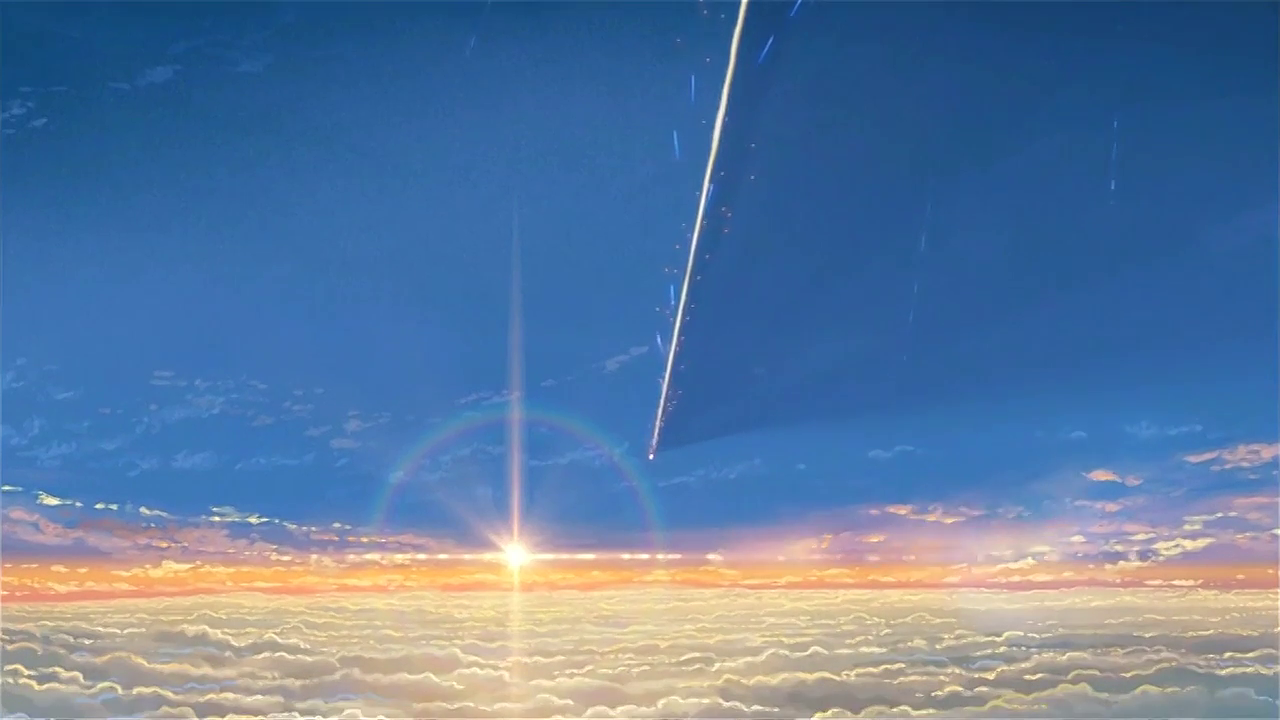
Early mornings are veiled in a muggy fog. It drifts across the fields and rooftops, diffusing the sunlight into a pale glow that carries summer toward its slow departure. Known as 蒙霧升降 (Fukaki kiri matô), or “deep fog descends and lifts,” this microseason marks a point in late summer when mornings arrive muted, carrying a softness that stands in contrast to the lingering heat of the afternoons.
Fog itself is made of boundaries dissolving. Warm, humid air cooling to its dew point allows invisible water vapor to condense into countless droplets, scattering light and softening the landscape into a blur. It’s a threshold between air and water, clarity and mystery. Explore the basics of fog's formation.
In Japanese art and poetry, fog often symbolizes transience—blurring mountains, bridges, and trees into soft silhouettes. A similar cultural idea appears in one of my favorite films, Kimi no Na wa (Your Name), where the two characters finally meet at kawatare-doki, the twilight hour when day and night blur together. That scene captures that pause where boundaries dissolve and time becomes something mysterious.
The fog lingers just long enough to remind me that not everything has to be sharp and defined. Summer is not yet gone, autumn not yet fully here, and in that in-between there’s a kind of quiet truth. As a programmer, I spend much of my time in a space where answers are precise, where problems reduce to yes or no and solutions can be traced step by step. Yet these blurred lines remind me how much of life resists such binaries. To live well is often to live within the fog itself, where clarity is softened and change is already underway.
霞に散り行く
秋の声
Even the sound of the waterfalls
scatters into the mist
voices of autumn